

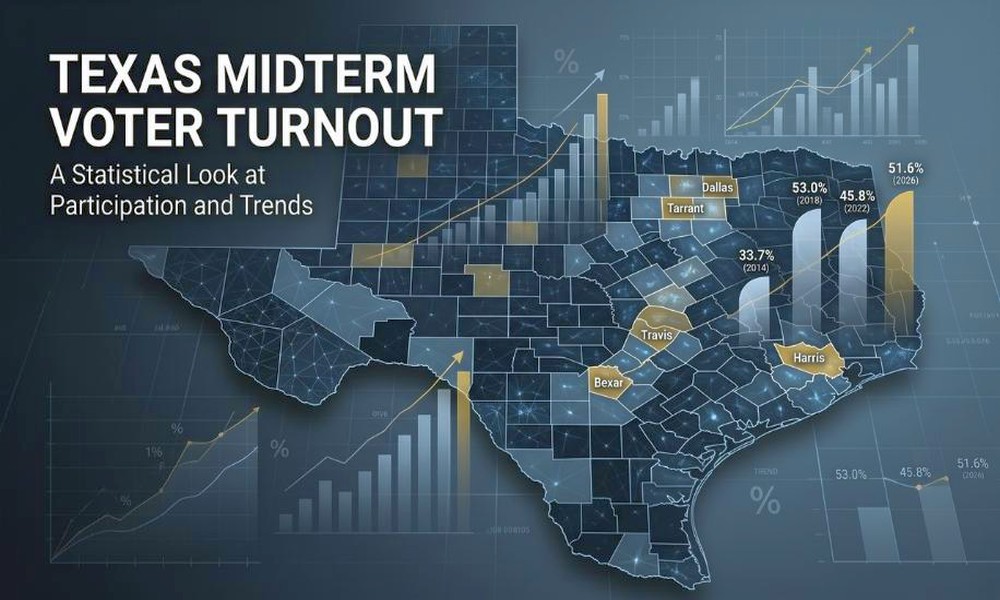
Texas midterm elections have experienced a structural transformation over the past twelve years, marked by expanding voter registration, higher turnout baselines, and an overwhelming shift toward early balloting.
Between 2014 and 2026, the state’s raw participation more than doubled. In the 2014 midterms, voter participation was relatively low, with only 4.7 million ballots cast from 14.0 million registered voters (33.7% turnout). The 2018 cycle initiated a major surge, drawing 8.4 million voters (53.0% turnout), followed by a resilient 8.1 million voters (45.8% turnout) in 2022 from an expanded pool of 17.7 million registered citizens. By 2026, voter rolls exceeded 19.2 million, and early estimates showed nearly 9.9 million total ballots cast, landing turnout between 51% and 52%.
Concurrently, voting habits moved decisively away from Election Day. In 2014, early and mail voting constituted roughly 53% of all votes. By 2018, that proportion rose above 73%, adjusted slightly to 68.2% in 2022, and reached approximately 78% in 2026. During the 2026 election, more than 7.7 million votes were cast before Election Day, driven overwhelmingly by in-person early voting (nearly 7.45 million) alongside approximately 263,000 returned mail ballots.
Geographically, voting power is concentrated in the state’s largest metropolitan centers. Five major urban counties—Harris, Dallas, Tarrant, Bexar, and Travis—generate over 40% of all ballots statewide. However, the highest percentage turnout consistently emerges from suburban “collar” counties like Collin, Comal, Fort Bend, Hays, and Williamson, which routinely record turnout rates between 57% and 60%. In contrast, border and South Texas counties, including Cameron, El Paso, and Hidalgo, exhibit lower participation levels, generally hovering between 41% and 44%.
Overall, the data reflects an electorate that has substantially enlarged its active footprint, with Texas voters increasingly consolidating their electoral participation into early voting windows.







Tanman
November 10, 2026 at 6:01 amAka. Transplants, immigrants, and democrats in urban areas decided this election and Texas will continue on this path for years to come.