What Are Red Tide Organisms: Biology 102
When someone describes something as Biology 101, they mean that the topic under discussion is simple to explain at an elementary level. As a degreed biologist I can tell you almost nothing in the field of biology is simple, i.e., Biology 101. This is particularly true of the organisms that cause Red Tide. We have to move up to the next level of understanding, which I call Biology 102 to understand what the Red Tide organisms are. Let’s try to nail down the Red Tide organisms:
Eukaryotes
You are a eukaryote. Eukaryotes are cellular organisms which have cells (1 or more) with a true nucleus (eu = true, karyote = nucleus). Eukaryotes may be further classified as Animals, Land Plants, Fungi, and Protists.
Protists
The Red Tide organisms are Protists. Protists are primarily single-celled, exhibiting a wide range of forms such as amoebae, ciliates (cilia are hairlike appendages that vibrate to aid in movement or creating currents), thick-walled microalgae and, more commonly, flagellates. The Red Tide organisms are mostly flagellates; more precisely, they are dinoflagellates. The picture below shows the great diversity found in dinoflagellates.
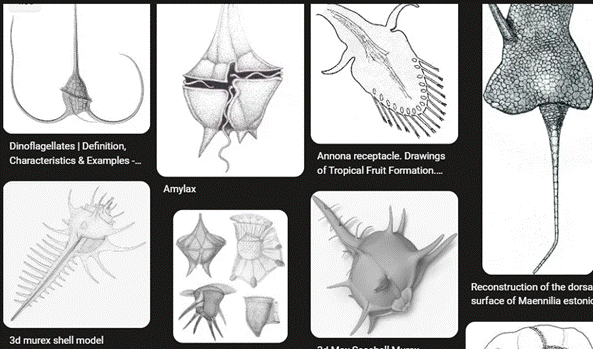
Dinoflagellates
Dinoflagellates (dinos = spinning), have one or more flagella, which are whip-like appendages that are long and rotate at high speed, sending the dinoflagellates flying across a microscope slide. Blink and they are gone. Protists are defined by what they are not. They are not plants, not animals, and not fungi. There are 12 identified species of dinoflagellates. That is about all we need to say about dinoflagellates and still keep us at the Biology 102 level. To say more would be taking us to a new class, Biology 103.
Karenia brevis- the Red Tide Organism
Karenia brevis is a toxic marine dinoflagellate responsible for Florida’s red tides, producing potent neurotoxins called brevetoxins that kill fish, harm marine mammals, and cause respiratory irritation and neurotoxic shellfish poisoning in humans. Karenia brevis is a microscopic, single‑celled, photosynthetic dinoflagellate found mainly in the Gulf of Mexico. It measures roughly 20–40 µm in diameter and moves using two flagella in a characteristic spinning motion. Because they are photosynthetic, Karenia have been classified in the past as algae, but they are distinct from algae in many ways. First, their cell walls are of different materials, with dinoflagellates having hard, shell-like cell walls. Second, while algae and Karenia produce energy through photosynthesis, the chlorophylls they use are different. Also, Karenia can ingest prey to obtain energy while algae only use photosynthesis.
Karenia brevis Toxins- a Double-edged Sword
While dinoflagellates other than Karenia also produce toxins, Karenia neurotoxins are the most potent. Karenia produces two broad types of neurotoxins. The first type is intracellular and accumulates in fish. Large blooms result in fish kills. The second type of neurotoxin is aerosolized and results in air contamination due to the bubbling effect of shoreside waves releasing the toxins into the atmosphere. This is the neurotoxin to which beachgoers are exposed. Aerosolized neurotoxins may be found in the same area as fish kills, but the neurotoxins are different. The aerosolized neurotoxins may also be encountered offshore due to being blown by the wind. You may avoid the intracellular toxins by not eating the fish (live or freshly caught). You may avoid the extracellular toxins by staying away from the beach during dinoflagellate blooms. Keep in mind that the aerosolized toxins may or may not be found near an obvious fish kill. Logic dictates that one should move upwind from a fish kill. The aerosolized toxins are not coming from the dead fish, but both types tend to be found in proximity to each other.
Summary
Dinoflagellate blooms are found along the gulf coast from Florida to Texas, although Florida tends to have more than its share. Blooms result in two different dangerous events. First, fish kills result due to fish ingesting neurotoxins produced intracellularly. Second, the neurotoxins can be released into the atmosphere by aerosolization. The aerosols float just above the surface of the water and can cause severe respiratory symptoms. What about the color? That comes from the photosynthetic pigments found in the dinoflagellates. Fishermen and recreational boaters beware.