
By J.Lee Austin
For the non-Entomologists, this strikingly geometric image is the wing of a Dragonfly, one of many that were strewn along the beach earlier this month. At first we were puzzled at the grisly scene, but soon learned that a fogging plane had made some low morning passes.
Precious government agencies presiding over our pesticidal campaigns are quick to assure us that toxin concentration and droplet sizes are completely safe for the other insects, the “non-target” bugs. Yeah, and the C19 needle is safe and effective. And Grandma can bench eight hundred. Drunk or sober.
The “application” was so recent that many were still alive, albeit writhing and twitching their last. Also littered among the corpses were the whimsically artful Gulf Fritillary Butterfly …
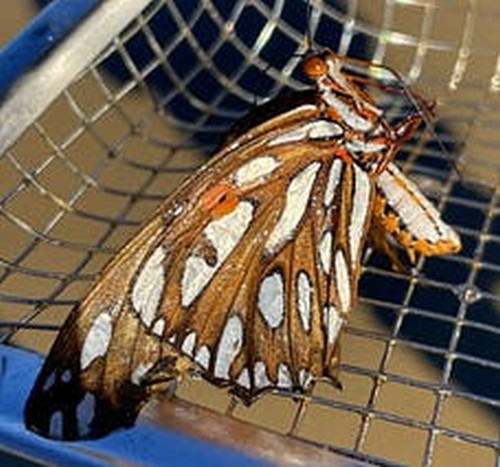
Guess we are incapable of managing some insects ourselves, so that now we let other fallible folks foul the air, land and sea for us. Good thing they don’t let us make important decisions.
Galveston County Mosquito Control confirmed spraying the peninsula with Dibrom that morning. No surprise there … it’s the Skeeter-killer of choice, notwithstanding the ever-popular Malathion, which is aerosolized from trucks into your yard at night. Highly toxic to bees and other beneficial insects, as well as some fish and other aquatic life, it has a half life of about 2 weeks. So glad that’s not long enough to seep into surface water, streams and soil.
Dibrom is classified as an “Adulticide” — meaning intended for the mature Mosquito rather than the larvae — and the active ingredient is Naled, a chemical so nasty that the European Union withdrew approval for its agricultural uses in 2005–2007 and then separately rejected the relevant biocidal uses in 2012. Yeah, but those people are nuts. Heads up Mona Lisa.
How about this nugget from the U.S. Fedgov National Pesticide Information Center:
Naled quickly affects insects when they touch, eat, or breathe it. Naled is a cholinesterase inhibitor, which causes the insect’s nerves to continuously ‘fire’. Usually this firing is stopped chemically inside the insect, but a breakdown product of Naled prevents enzymes in the insect from working correctly. The insect’s nerves are then stimulated constantly, and eventually the insect dies.
So, death by catastrophic nervous overload … internal electrocution. But as we saw first-hand on the beach, the poison can’t tell the difference between a Mosquito and a Dragonfly … which ironically enough, Eats Mosquitoes Mucho! Expert pilots, they skillfully catch the adult Skeeters on the fly while the nymphs slurp up their larvae in the water. Double Duty Dragons if you will.
The strongest quantitative evidence comes from a 2023 meta-analysis in the Journal of Animal Ecology. Researchers combined findings from 31 studies covering 47 dragonfly and damselfly species, and nine mosquito species. Their results showed that a single aquatic Dragonfly or Damselfly nymph consumed an average of about 40 mosquito larvae per day, a daily reduction of 45%. So we mass gas them to agonizing death. Small wonder the aliens keep passing us by.
How about the side effects of Naled on human biology, which according to the National Pesticide Information Center,
… is severely irritating if a person gets it on their eyes or skin. It is considered corrosive and direct contact could lead to permanent damage.
At my ripe stage, permanent damage gets a little more temporary every day, but you Grands most certainly have some skin in this game.
Then there’s the Rats, always the friggin’ Rats. As you might guess, hapless rodents breathing low doses of Naled for four hours got the diarrhea. Moderate doses caused body tremors, more diarrhea, and difficulty walking. So about like an average night on Bourbon Street.
Similar to other Organophosphates, overexposure from direct inhalation can lead to tightness in the chest, wheezing, cough, increased saliva, runny nose, blurred vision, tearing, and headache. Come to think, I actually have teared up recently. But that was probably the day I realized Baywatch is never coming back.
Since moving to the Gulf of Texas over three years ago, I have had bouts of chronic cough lasting weeks at a time. And this was well before the noxious Red Tide bloomed ashore. Daily nasal mucus production is now excessive, beyond that of a slimy Snail or sniveling Ex.
Also had a couple episodes of chest tightening, which I attribute to Dysfunctional Esophageal Motility. Yeah, that’s a real mouthful, I know. Hard to swallow even. ChatGPT was quick to lecture me that gullet spasms can mimic a heart attack, and sternly ordered me to get myself to the emergency room right this second, forget finishing those grits and beer.
Since it felt exactly like my previous episode (when a chunk of chicken choked me to tears), I skipped the ER and had my blood Troponin level drawn, which was normal. I guess Artificial Intelligence means well and is programmed for extra caution, but I swear, sometimes he can’t tell Shinola from a Shitzu. But I digress.
With a large exposure, Naled effects can include lightheadedness, slurred speech, muscle twitching, irregular heartbeat, convulsions, paralysis, coma, and even death. More common in children are muscle weakness, salivation, constricted pupils, seizures, lethargy, and coma. Nothing funny about that.
Of course we’ve all been trained to fear microscopics like the West Nile, the Yellow Fever, the Dengue, Malaria and Encephalitis for St. Louis Horses or something like that. While it’s true that Mosquitoes can carry these little microbial misfits around, your chance of dying from these diseases in the U.S. is vanishingly small. About as likely as me getting a drive-by tongue piercing.
But hey, don’t get me wrong. I hate the evil little vampires as much as the next red-blooded American. After any given hatch, I can be found skulking in dark corners, flashlight and swatter at the ready. Paw Paw Fudd got nuthin’ on me.
I suppose the question is whether the benefits of dousing ourselves with harsh chemicals outweigh a slap-and-scratch nuisance, which can often be mitigated with lightweight, long sleeve and britches attire that the experienced anglers sport. What say you Dear Reader? To spray or not to spray? That is the question.
Best of luck to all, especially those downwind,
~ ~ j ~ ~
“When the Mosquitoes get thick, breathe through your teeth.”
~ ~ John Lyman, Eminent Marine Biologist, & Fishing Buddy
J. LEE AUSTINJ. Lee’s Stack, The Good Help Network is a reader-supported publication. To receive new posts and support my work, consider becoming a free or paid subscriber.