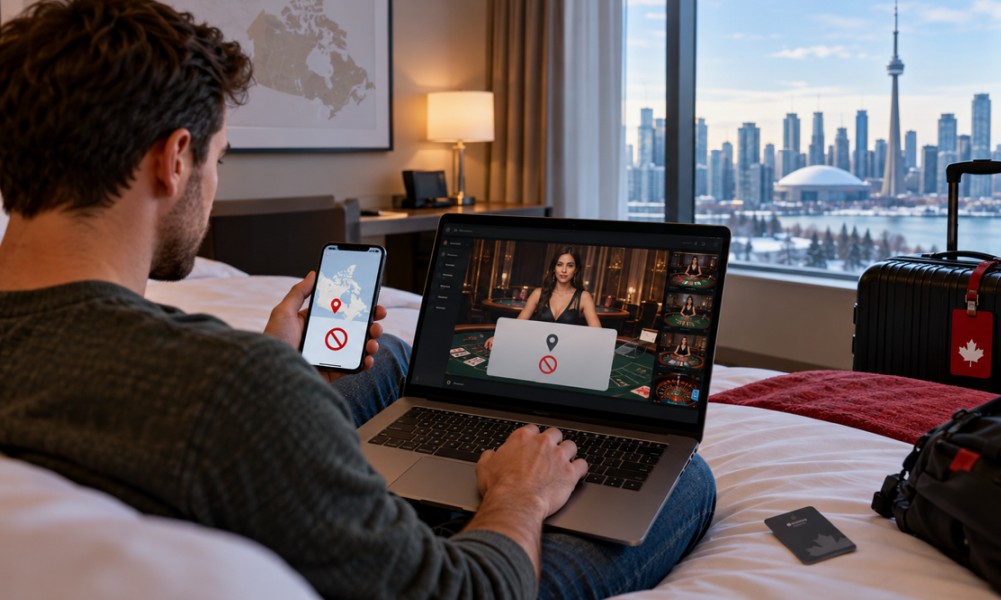
A traveler from Texas checks into a Toronto hotel and connects to the Wi-Fi. Most websites load without trouble. Others behave differently. A streaming service shows a different catalog, certain payment features disappear, and a gambling platform asks to verify the device’s location before accepting a wager.
Those restrictions come from rules that determine where particular services can operate. In Canada, those rules can change at a provincial border, even when someone remains in the same country.
Why some online services work differently abroad
A website being accessible does not mean every feature is available wherever someone travels.
Streaming catalogs vary because distribution rights are negotiated for particular territories. Financial services face local restrictions, while gambling operators need permission to accept wagers in the jurisdictions they serve.
Canada leaves much of its gambling regulation to the provinces. Each has its own arrangements for licensing or authorizing gambling services, with no single system covering every operator nationwide.
The rules also affect platforms offering live casino canada games. A dealer may broadcast a roulette table from a studio overseas, but receiving that video does not necessarily mean a customer can place a wager from their current location. ToonieBet, makes its live-dealer lobby available to customers in Canada outside Ontario, alongside more than 5,000 casino games and a sportsbook.
Traveling can therefore change what an existing account allows, even though the account itself remains active.
What happens when someone crosses into another province
Ontario requires customers to be physically inside the province when placing wagers through its regulated internet-gaming market. Having an Ontario address or completing registration there is not enough.
The distinction becomes apparent when an Ontario resident spends a weekend in Montreal. They may still sign in, review account information and check previous transactions, but wagering is unavailable until they return to Ontario.
iGaming Ontario’s player guidance confirms that accounts can remain accessible outside the province while betting is restricted.
A visitor from Texas faces a different situation. While physically in Ontario, they may meet the geographic requirement despite living elsewhere. Age, identity and the operator’s other eligibility checks still apply.
Quebec and other provinces have their own arrangements. Rules that apply to an Ontario-regulated account cannot simply be assumed to apply throughout Canada.
How a website knows where a traveler is
An address entered during registration says little about where someone is sitting months later. Location checks rely instead on information from the device and its internet connection.
An IP address can suggest a city or region, although it is not always precise. Smartphones can provide GPS coordinates, while nearby Wi-Fi networks and cellular connections offer additional location information.
A platform may examine several of these signals before allowing a restricted transaction. Which ones it uses depends on the verification technology.
This explains an otherwise confusing situation: a customer can log in successfully and still be unable to wager. The password establishes access to the account. It does not prove the customer is currently somewhere the operator can legally accept bets.
Nothing needs to have changed in the customer’s registration details for that restriction to appear.
Why hotel Wi-Fi can cause location errors
Hotel networks do not always send internet traffic directly through equipment near the building. Some route connections through servers elsewhere, leaving websites with an IP address associated with another location.
Roaming phones can produce similar confusion. A visitor using a foreign mobile network may have data routed through their home carrier, making the connection appear to originate somewhere else.
VPNs add another complication. They can show websites the location of a remote server rather than the device itself.
A location-verification service may respond to conflicting information by requesting another check or refusing the transaction. That does not necessarily mean the account has been suspended.
These problems are particularly noticeable during travel, when people move between hotel networks, public Wi-Fi and mobile data.
Using technology to disguise a location is a separate matter and may breach gambling regulations or a platform’s terms.
What visitors need to know about Canadian rules
Location is not the only condition governing access. Age and identity checks also apply, and the requirements vary across Canada.
Ontario sets the minimum age for its regulated online gambling market at 19. Other provinces have different rules, including age limits.
Live-dealer games follow the same basic geographic restrictions as other regulated gambling products. The studio can be thousands of kilometers away, but the customer’s location still matters when a wager is accepted.
Spending limits, self-exclusion and provincial gambling-support services are available for people who need help managing gambling activity. Location restrictions do not replace those safeguards.
For someone traveling through Canada, an unavailable wagering feature does not necessarily signal a faulty account or a broken connection. The service may be working exactly as intended, applying the rules of the province where the customer is currently located.