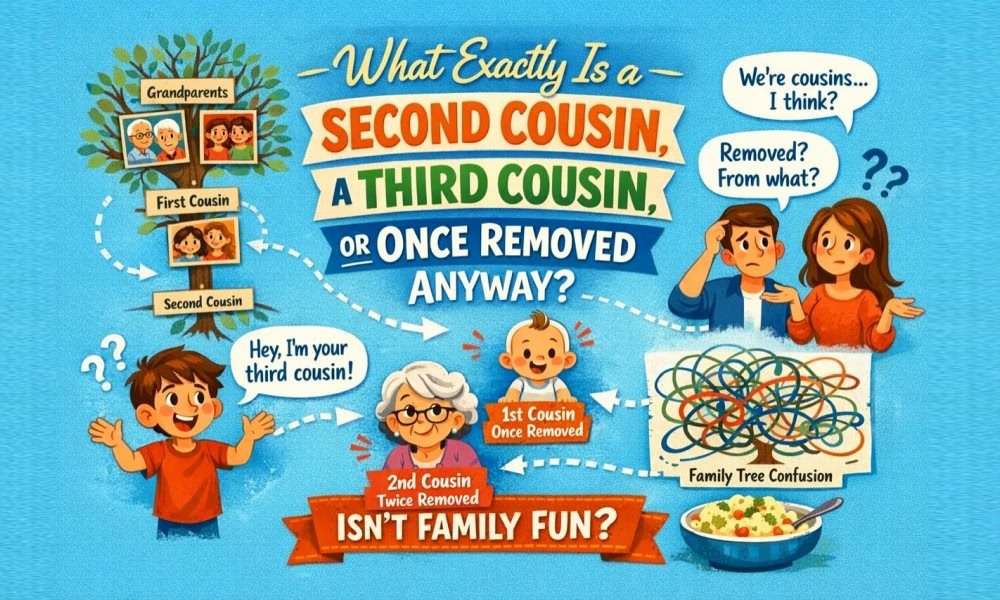
If you have ever stood at a family reunion holding a paper plate of potato salad while someone cheerfully says, “This is your third cousin once removed,” and you just nodded like that made perfect sense, you are not alone. Family relationships have a way of sounding like a complicated math problem that no one remembers how to solve. Cousins especially live in that mysterious gray area where everyone is related but no one is quite sure how.
Let us clear it up once and for all, without a flow chart, a whiteboard, or a headache.
First things first: what is a cousin?
Your first cousins are the easiest to understand. These are the children of your aunts and uncles. You share grandparents with them. If you grew up seeing them at holidays, weddings, or backyard cookouts, those are first cousins. Simple. Comfortable. Safe territory.
Now this is where the family tree starts growing branches in every direction.
Second cousins: still family, but a step farther out
Second cousins are the children of your parents’ first cousins. In other words, you and your second cousin share great grandparents.
Think of it like this. Your grandparents had children. Those children had children. Those children then had children. If you are comparing notes with someone whose grandparents are the same as your great grandparents, congratulations, you have found a second cousin.
Second cousins are usually people you recognize as family but might not see often. They are the ones you vaguely remember from one wedding ten years ago or from that one reunion where everyone wore matching shirts.
Third cousins and beyond: family in theory
Third cousins share great great grandparents. Fourth cousins share great great great grandparents. By the time you get here, the family connection starts to feel more philosophical than practical.
You might hear someone say, “We are related somehow,” and technically they are right. But you probably do not share childhood memories, inside jokes, or even last names. These are the relatives you discover through genealogy websites or long conversations with a very enthusiastic family historian.
They are still cousins, just very distant ones. Family, but in a “we might not recognize each other at the grocery store” kind of way.
Now let us talk about “once removed”
This is the part that confuses almost everyone.
“Removed” does not mean divorced from the family or kicked out after Thanksgiving dinner. It simply means there is a difference of one generation between two relatives.
Once removed means one generation apart. Twice removed means two generations apart.
Here is the easiest way to think about it.
If your cousin has a child, that child is your cousin once removed. If your cousin has a grandchild, that person is your cousin twice removed.
The same rule works going the other direction. Your parent’s cousin is also your cousin once removed. Same relationship, just older instead of younger.
The word “removed” sounds dramatic, but it is really just a polite way of saying “not in the same generation.”
Putting it all together without losing your mind
Let us say you have a first cousin named Sarah. Sarah has a son named Jake. Jake is your first cousin once removed.
If Jake grows up and has a daughter, she becomes your first cousin twice removed.
Now let us say your mom has a first cousin named Linda. Linda is your first cousin once removed. Linda’s kids are your second cousins.
Yes, this sounds complicated. No, you are not expected to do this math in real time at a family barbecue.
Why we all just say “cousin”
Here is the truth. Outside of genealogy projects and trivia night, most people just say “cousin” and move on with their lives. It is simpler, faster, and avoids awkward pauses.
If someone introduces you as a third cousin twice removed, you are not required to gasp in excitement or ask follow up questions. A polite smile and a friendly hello will do just fine.
The exact label rarely changes the relationship. What matters more is whether you grew up together, keep in touch, or share stories and traditions.
When it actually matters
Knowing these distinctions can be useful when researching family history, building a family tree, or trying to explain to your kids how everyone is connected. It can also help settle friendly debates that start with, “Wait, how are we related again?”
It is also helpful when you realize that family trees do not just go straight up and down. They spread out in every direction, connecting people across generations, time, and geography.
The bottom line
First cousins share grandparents. Second cousins share great grandparents. Third cousins share great great grandparents. “Removed” just means a generational difference.
If that still feels like too much, remember this. If you share family stories, holidays, or laughter, you are family. The exact cousin number is just a footnote.
So next time someone says, “We are cousins, once removed,” you can confidently smile and think, “Got it. Family. Pass the potato salad.”