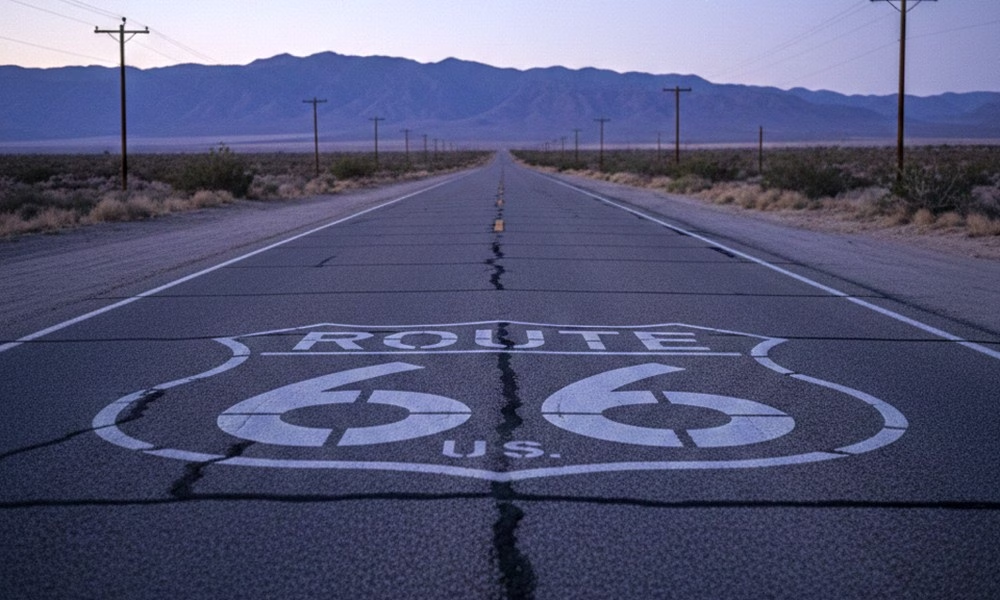
America is a country defined by movement. Since the invention of the automobile, the road trip has become a central part of the national identity. From historic trade routes to neon-lit boulevards, certain stretches of asphalt have transcended their utility to become cultural icons. However, the modern journey is about more than just the destination. It is a mix of high-tech convenience, infrastructure fatigue, and the age-old debate between the marathon drive and the leisurely scenic tour.
Route 66: The Mother Road
Running from Chicago to Santa Monica, Route 66 is perhaps the most legendary highway in the world. Established in 1926, it served as a primary route for those migrating west during the Dust Bowl. While it was officially decommissioned in 1985, its legacy lives on through preserved diners and vintage neon signs. It remains a symbol of 20th-century optimism.
Today, driving this route requires a choice. Some travelers choose the “Iron Butt” marathon, aiming to cover 800 miles in a single sitting to reach the coast. Others choose a scheduled adventure, stopping at every “world’s largest” roadside oddity to maintain mental acuity and enjoy the local culture.
Las Vegas Boulevard: The Neon Canyon
Known simply as “The Strip,” this 4.2-mile stretch is world-famous for its concentrated collection of resort hotels and casinos. Since 1941, the road has evolved into a glowing neon canyon that defines American entertainment.
This road also highlights the importance of illuminated highways. Well-lit corridors in urban areas significantly reduce driver fatigue and eye strain. Proper lighting makes lane changes safer in high-traffic environments, though it can’t always save you from the gridlock typical of a Friday night in Vegas.
Pennsylvania Avenue: America’s Main Street
Few roads carry as much political weight as the stretch of Pennsylvania Avenue connecting the U.S. Capitol to the White House. It has hosted centuries of presidential inaugurations, state funerals, and historic protests.
However, even the most powerful mile in the world isn’t immune to the ubiquitous orange barrel. No American road trip is complete without construction zones. While essential for long-term safety, these projects create unpredictable delays that can derail even the most meticulously planned itinerary.
Broadway: A Living Timeline
Manhattan’s Broadway is one of the oldest streets in America, dating back to the Dutch settlement of New Amsterdam. It is unique for the way it cuts diagonally across the city’s rigid grid system.
Walking or driving Broadway serves as a reminder of the good, the bad, and the questionable in American transit. The good is the unprecedented connectivity of modern cities. The bad is the aging infrastructure and rising tolls. The questionable remains the human element: the decision to drive while exhausted or the over-reliance on semi-autonomous driving systems in dense traffic.