

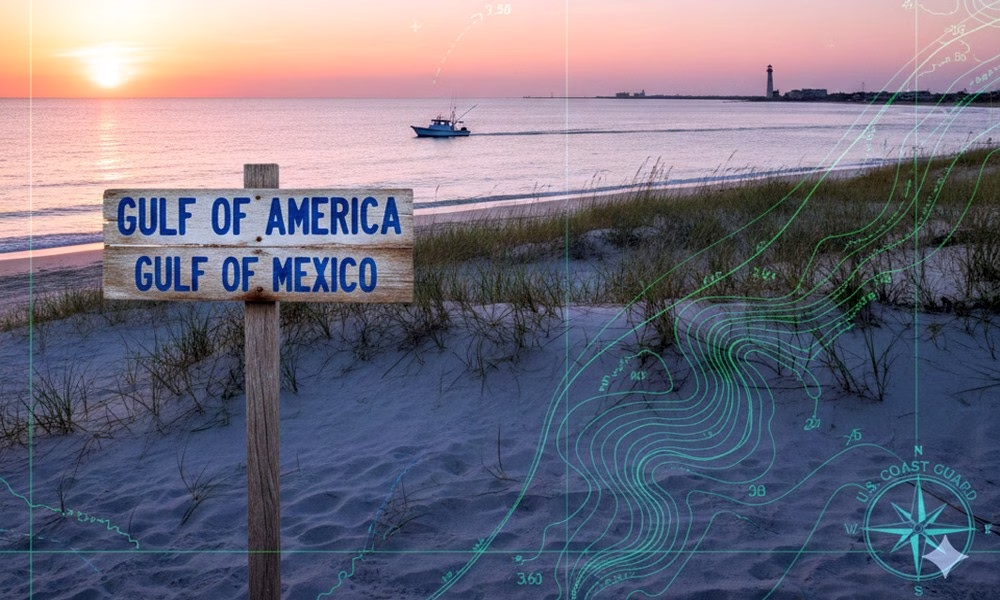
The waters that define our very way of life on the Bolivar Peninsula have a new, official name, at least according to the federal government. On January 20, 2025, an Executive Order officially directed all federal agencies to rename the Gulf of Mexico as the “Gulf of America.” As we settle into 2026, this shift is moving beyond political discourse and into the practical realities faced by our coastal community.
For generations, “Gulf of Mexico” has been etched onto maps, whispered by fishermen, and sung in songs. It’s a name deeply woven into the fabric of our regional identity and culture. The change, spearheaded by nationalist sentiments citing the Gulf’s strategic importance and its geographic encompassment primarily by U.S. shores (with the exceptions of Mexico and Cuba), aims to reassert American influence over this vital body of water.
While the international community, along with many private mapping services like Google Maps and Apple Maps, has been slow to adopt the new nomenclature, the federal government is moving full steam ahead. This means that if you’re out on a shrimp boat or navigating your recreational vessel off Crystal Beach, the NOAA nautical charts you consult are increasingly reflecting the “Gulf of America” designation. The U.S. Coast Guard, too, now refers to it officially in their communications, patrols, and emergency responses.
Local Impact and Political Resonance
Here on the Bolivar Peninsula, the change resonates in unique ways. Our very existence is defined by these waters, from our fishing industry to tourism, and from hurricane protection to our daily sunsets. State Senator Mayes Middleton, who represents Galveston and the Bolivar Peninsula, has been a vocal proponent of the name change. He has actively pushed for state-level legislation to align Texas statutes and official state documents with the federal directive, emphasizing the economic and national security importance of the Gulf to the United States.
“This isn’t just a name change; it’s a recognition of the immense value and primary stewardship the United States holds over these waters,” Senator Middleton stated in a recent press release. “It reflects a geopolitical reality and ensures our federal resources are focused on an unequivocally American asset.”
For local businesses, the adoption of “Gulf of America” is a mixed bag. Many established businesses, deeply rooted in tradition, may be hesitant to update their signage, marketing materials, and websites, which proudly feature “Gulf of Mexico.” Changing logos, brochures, and brand identities represents a significant cost and a departure from a long-standing heritage. However, newer businesses or those looking to appeal to a more nationalistic tourist base might see it as an opportunity.
Beyond the Name: Practical Considerations
Beyond the cultural and branding implications, the name change also impacts various federal programs critical to the Bolivar Peninsula. Projects involving beach nourishment, spearheaded by the Army Corps of Engineers, and coastal protection initiatives are now officially operating on the “Gulf of America.” This could streamline certain federal funding applications and inter-agency collaborations by removing any perceived ambiguity about jurisdiction or primary beneficiaries.
Environmental monitoring, scientific research, and oil and gas regulations are also falling under the new designation. Researchers applying for federal grants, for instance, are now expected to use “Gulf of America” in their proposals, subtly reinforcing the new standard across scientific and industrial sectors.
Ultimately, while you likely won’t see locals spontaneously changing their informal references overnight, the “Gulf of America” is becoming the official lens through which our federal government views and interacts with our precious coastal waters. It prompts a conversation about identity, tradition, and the evolving geopolitical landscape that touches every wave that laps onto our beautiful shores. As residents, understanding this shift is key to navigating the future of our beloved coastline.








Pat Ritchie
January 13, 2026 at 1:59 pmThis is very helpful thank you. Unfortunately, when our president declared this change, he presented no logic or reason so it appeared that the name change was just a tacky power grab and very hurtful for those of us who have made our home here along the coast. Thank you for presenting the logical aspects of the change. Perhaps my resentment will wane.
J. Lee Austin
January 14, 2026 at 9:25 amGood points Pat, keep the resentment. When a self-anointed King of the World starts changing map names on a whim, you know we’re in the deep end of the pool. No single person should have that kind of power and those cheering it on may get their hat handed to them when AOC changes it back. I’m calling it the Gulf of Texas until then!
Best of luck friend,
~~ j ~~