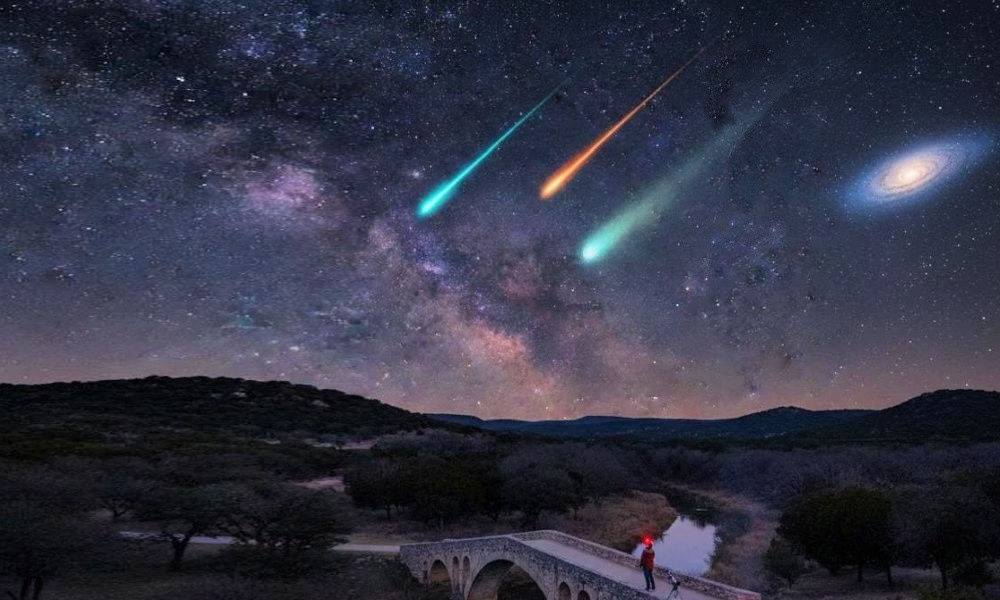
An Interstellar Visitor, Solstice Magic, and Winter Meteors Grace Texas Skies
December brings a celestial smorgasbord to the night sky, offering Texans a unique blend of rarity, ancient tradition, and sparkling meteor showers. As the year draws to a close, look up to witness an interstellar comet, the longest night of the year, and a final burst of winter meteors—all under the blanket of a brand new moon.
A Rare Interstellar Guest: Comet 3I/ATLAS
Imagine an object traveling for millennia from beyond our solar system, making a brief, silent pass through our neighborhood before continuing its endless journey. That’s precisely what Comet 3I/ATLAS is doing. This mysterious visitor, an “interstellar comet,” made its closest approach to Earth on December 19th.
What makes it special? 3I/ATLAS is only the third object ever confirmed to have originated from another star system.Unlike typical comets born in our solar system, its trajectory indicates it came from deep space. While you’ll need at least a 30cm (12-inch) aperture telescope to spot this faint, fuzzy visitor, its mere presence reminds us of the vastness and wonder of the cosmos. For dedicated Texas astronomers with powerful equipment, hunting for 3I/ATLAS offers a truly once-in-a-lifetime observing challenge.
The Winter Solstice: Longest Night, New Beginnings
On December 21st, at 9:27 PM CST, we officially welcome astronomical winter in the Northern Hemisphere with the Winter Solstice. This isn’t just a date on the calendar; it’s a precise astronomical moment when the Earth’s North Pole is tilted farthest away from the Sun.
Relevance to Texans: For us, it means the shortest day and the longest night of the year. While the daytime may be brief, the extended darkness offers more hours for stargazing. Historically, the Winter Solstice has been a time of reflection, renewal, and celebration of the returning light. Many cultures throughout history have observed this pivotal moment, marking it with festivals and rituals. It’s a perfect evening to gather with loved ones, perhaps by a warm fire, and appreciate the night sky.
The Ursid Meteor Shower: A Subtle Winter Sparkle
Just as the Geminids fade, another meteor shower quietly takes center stage. The Ursid Meteor Shower will peak on the night of December 21st into the early morning hours of December 22nd.
Viewing in Texas: The Ursids are a smaller shower, producing about 5-10 meteors per hour. However, this year’s viewing conditions are excellent! With the new moon ensuring very dark skies, even the fainter meteors should be visible. To spot them, locate the constellation Ursa Minor (the Little Dipper), which contains Polaris, the North Star. The meteors will appear to radiate from this area. It’s a perfect, low-key stargazing activity for the long solstice night. Head to a dark-sky location away from city lights (Texas boasts several excellent dark-sky parks and rural areas) for the best experience.
The New Moon: Dark Skies for Deep Gazing
Rounding out this week of celestial activity is the New Moon on December 20th. This phase occurs when the Moon is positioned between the Earth and the Sun, making it invisible to us.
Why it’s great for stargazers: A New Moon means incredibly dark skies! Without moonlight to wash out fainter objects,the nights immediately surrounding December 20th are ideal for observing distant galaxies, star clusters like the Pleiades (the Seven Sisters), and nebulae with binoculars or a telescope. Texas, with its vast stretches of rural areas, offers prime dark-sky opportunities to truly appreciate the faint wonders of the universe during this period.
So, bundle up, grab a warm drink, and step outside this week. From an extraordinary interstellar traveler to the quiet beauty of a winter meteor shower under the longest night, December offers a spectacular reminder of the universe’s endless marvels.