

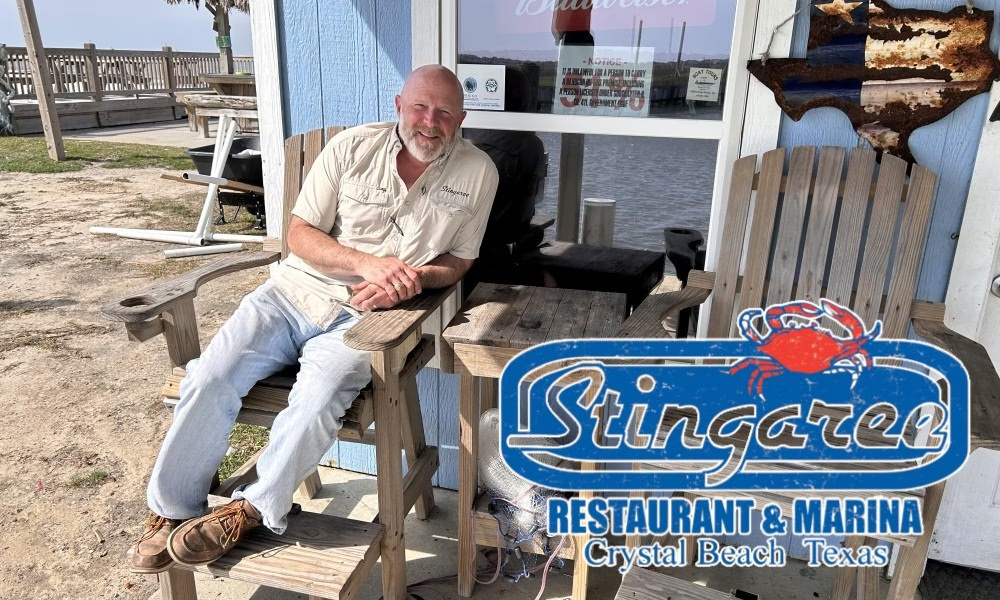
For many, the end of the road on the Bolivar Peninsula isn’t just a geographical point; it is a destination. At the heart of that destination sits Stingaree Restaurant and Marina, a staple of Southeast Texas hospitality approaching its 40th anniversary. We sat down with owner Brad Vratis to discuss the transition from corporate shoes to coastal seafood, the transformation of “Down Under,” and what it means to run a business that serves as a community cornerstone.
The conversation naturally drifted toward his roots. Brad comes from a long line of Greek restaurateurs, but the path to the helm of Stingaree wasn’t a straight line. “My grandfather went to the University of Texas, got his law degree, and never practiced a day in his life,” Brad said with a chuckle. “He ran a restaurant until the day he died.
Despite the family history, a young Brad wasn’t looking for a kitchen to call his own. In the early 2000s, he was in Houston, climbing the corporate ladder for Journey Shoes. He was making good money and enjoyed the fast-paced growth of the brand. It took a vacation in Mexico for his father to plant a seed that would change everything.
“We were both reading books on the back of the boat, and Dad asked, ‘What do you think about running a restaurant?’ I didn’t even look up. I just said, ‘Never.'”
But the pull of hospitality—the kind he saw his grandmother model for years—eventually won out. “I’m glad I did it because it fulfills me,” he admitted. “Taking care of people and giving them a good experience… that’s what makes me happy.
A Landmark Born of Budweiser and Oysters
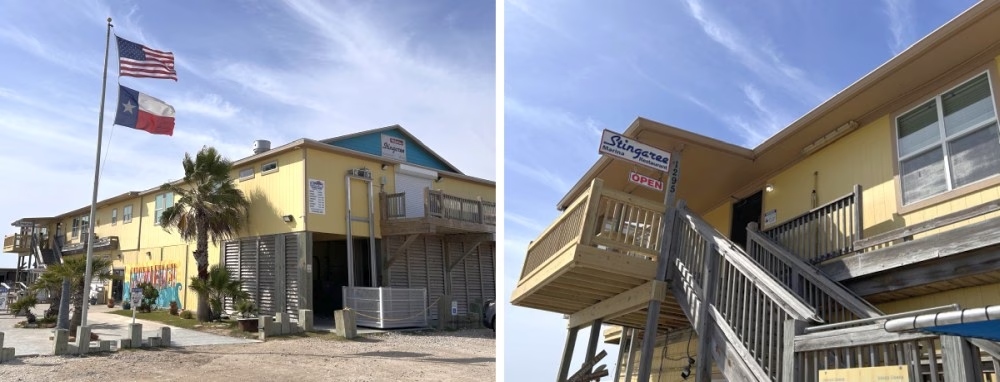
Stingaree officially opened its doors on December 13, 1986. The name was borrowed from Stingaree Cove, a navigational mark on local charts. It began as a vision shared between Brad’s father and his Uncle George, likely over a “Budweiser and a raw oyster,” Brad imagined.
Brad was only 11 years old when the restaurant opened. Growing up in the woods of Splendora, the peninsula was a weekend “spectacle of sights” for him. “It was regular Tom Sawyer stuff back home,” he recalled, “but then I’d get down here and see all these people coming to my dad’s and uncle’s restaurant. It was wild and wide open.”
This year marks the restaurant’s 40th anniversary. To celebrate, Brad plans to repeat a tradition from their 30th anniversary: serving the original 1986 menu. “Selling snapper for $8.95 a fillet doesn’t feel good on the pocketbook,” he joked, “but it feels good to give back to the community that built us.”
The Evolution of the Experience
When Brad took over the reins in 2007, the transition wasn’t exactly smooth. “It sucked,” he said bluntly. Though he had managed the place for years, the weight of 100% financial responsibility in 2013 was an eye-opener. He described the business not as a machine, but as a living entity. “It’s like another human. It’s like a baby that you have to nurture.”
He credits a mentor, Jim Broussard, with teaching him the most valuable lesson in the industry. “Jim asked me how it was going, and I said, ‘Man, we’re selling fried shrimp, just making it happen.’ He told me, ‘When you learn how to sell the experience, that’s when you’ll make a living.’ It didn’t register then, but it does now.”
Stingaree doesn’t claim to be five-star fine dining; its identity is built on consistency and “good vibes.” However, that hasn’t stopped the menu from evolving into a local powerhouse. The Redfish Louie is the undisputed king of the kitchen.
“We used to sell 20 pieces a week and think that was great,” Brad said. “Now, we sell 20 cases of fish a week.” While the fried seafood platter remains the Southeast Texas staple, Brad encourages experimentation. “I don’t think a kitchen is different than art. An artist can’t draw the same stick figure their entire life. We experiment because we get tired of cooking just fried shrimp.”
To wash it all down, guests reach for the Stingarita, a signature house margarita known for its high alcohol content and a unique splash of orange juice. Brad also brags about Mermaid Water as another popular specialty cocktail, crafted by a former bartender. “People love it.”
Keeping it Local
Authenticity at Stingaree starts with the sourcing. If it’s local, Brad buys it. Snapper comes from Katie’s Seafood, blue crabs from Delino Comeaux, and even the oysters are sourced from local farms like the one started by David Kohlhofer.
“We pride ourselves on being a local business doing local business,” Brad emphasized. This commitment to the community is also reflected in his staff. Some have been with the restaurant for years. The longest-tenured employee right now is Brandye Duhon, now in her 28th year. When she had her 25th anniversary at the restaurant, Brad sent her and her husband down to the Florida Keys as a thank-you for her decades of loyalty—and for the time she “cussed him out” to put him back on the right track when he was a young manager.
“Down Under”: From Overflow to Identity
One of Vratis’s biggest contributions to the legacy was redefining the “Down Under” space. Originally used as a screened-in overflow area to wait for tables upstairs, it cycled through several identities before Brad leaned into his love for the Texas and Louisiana music scenes.
“I didn’t want it to just be an afterthought overflow. I wanted it to have its own identity,” Vratis says. By bringing in live music, supported by local artists and friends like Blue Broussard, he transformed the space into a premier open-air venue.
However, Vratis is careful not to let the success polish up the charm. “I don’t ever want to have to have a tablecloth,” he insists. “That authenticity of what Stingaree started as, I want that to be always some part of what we do.”
The Future: Filling the Gaps
Brad isn’t content to just sit on 40 years of success. This April, he is opening a fresh fish market on the property. “Entrepreneurship isn’t about reinventing the wheel; it’s about filling a gap in the market,” he explained.
The market will sell locally sourced shrimp, blue crabs, and fresh fillets, filling a void left by the closure of older markets like Milt’s. It also serves a personal purpose: “I’m creating a job for my kids. My daughter and her friend are going to run that little market this summer.”
The End of the Road
What makes Stingaree special? According to Brad, it’s the sense of escape. “No matter how much concrete we pour, when you get to the end of this road, you’re at a place that’s been the same for 40 years. It gives the vacation authenticity.”
He noted a unique perspective on the Bolivar Peninsula: almost everyone there is there by choice. “Few people are born here and stay,” he said. “People choose to be here. That’s a cool perspective.”
As the interview wrapped up, Brad reflected on the “good vibes” that have sustained the restaurant through decades of hurricanes and changing tastes. Seeing people propose at the tables or bring their grandkids in for their first fried shrimp dinner is what keeps him going. At Stingaree, the sunsets might be free, but the memories are what keep the doors open.






Larry Flanagan
February 24, 2026 at 6:52 amGreat article. One Bolivar Icon interviewing another Bolivar Icon. “It don’t get no better than that “.